
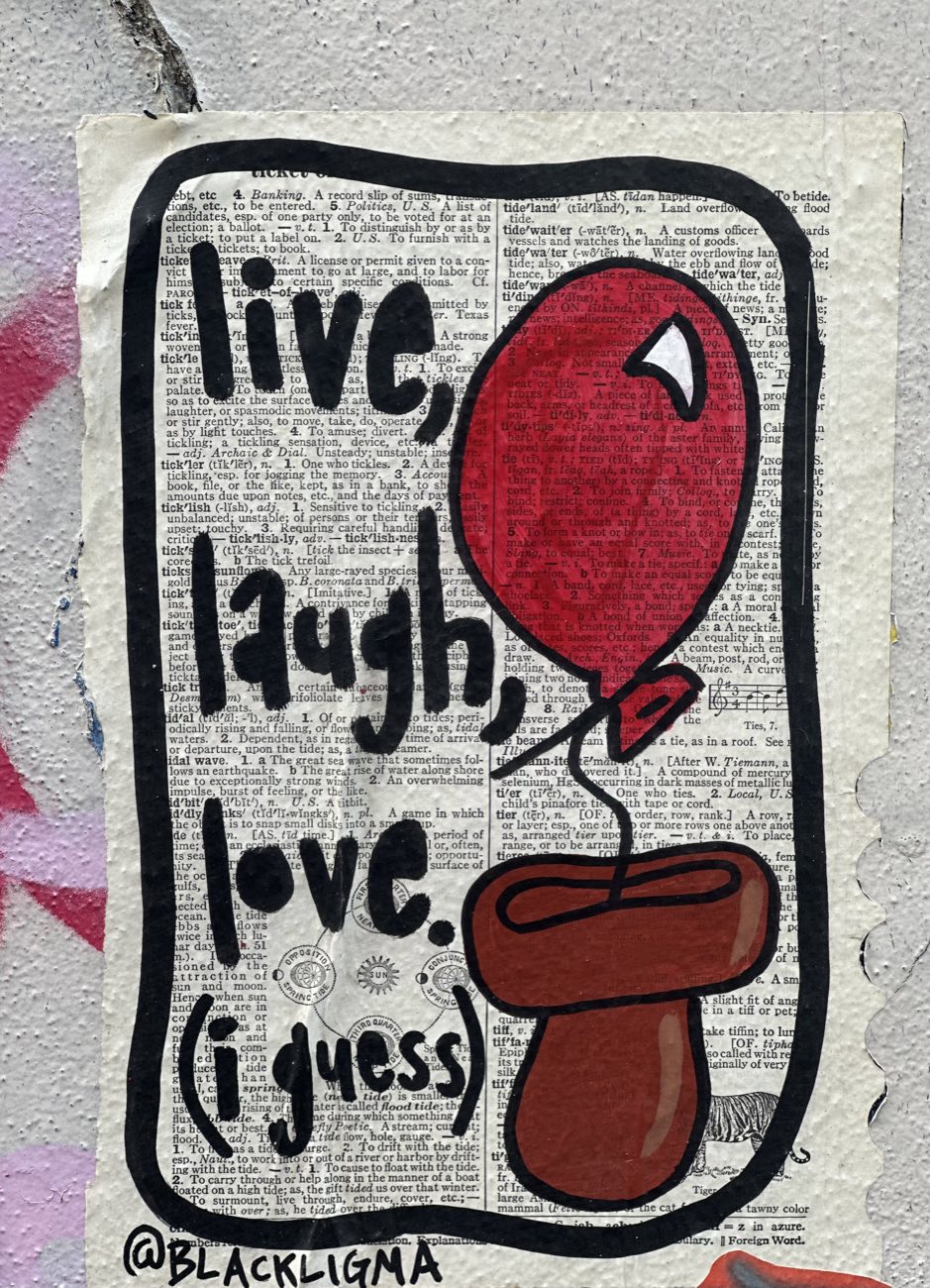
Words have meanings, and those meanings change over time. That's normal. But when we use a word too loosely, it can change how we see ourselves and other people.
"Trauma" can describe an experience that overwhelms a person's capacity to cope and has a lasting impact. Today it's often used for anything bad that happened to us, even if it shook us for just a day. "OCD" is a clinical diagnosis, yet it's now what we say when someone likes their clothes hung by colour.
In each case, the word hasn't simply changed. It has been overused and trivialised until it lost much of its weight. If every bad experience is trauma, what word is left for experiences that turn our lives upside down? If being tidy is OCD, how do we describe the reality of someone living with relentless compulsions?
This article is my take on four words from the psychology and wellness space that I find among the most misused, predominantly on social media: healing, narcissism, alignment and spirituality. Rather than defining them precisely, I want to point to the virtue signalling and self-deception we slip into when we use them to suit our needs, and why I think being aware of this matters.
Healing
In its original sense, healing is what happens when a wound closes or the body recovers from illness: something damaged is restored to health. In psychology and the wellness world, it has come to mean recovering from emotional wounds, whether from trauma, difficult relationships, or old cognitive and behavioural patterns we would rather leave behind.
Someone I know once described an intense course of therapy she had been through and what she had learned, and ended the story with: "And then I was healed." I remember how strange it sounded, as if healing were something we could finish. Ta-da!
I suspect this is how many of us now understand our "healing journey." It's something we do consciously, by dedicating time and money to it, and most importantly, by talking about it (a lot), ideally on social media.
If we do enough therapy, sit in enough psychedelic ceremonies, or attend enough breathwork sessions, we will arrive at a moment after which we are healed. The work is done. We feel at peace, we no longer get triggered, and our relationships finally work. And we have certainly earned the badge that signals our superiority over people who are supposedly just out there living carelessly, oblivious to the fact that they could heal at all, while we invest thousands of euros and hundreds of hours in becoming a "healthy" version of ourselves.
Well, I call bullshit. We can heal specific things, but I don't think we arrive at a final state of being "healed." What many people label as healing is usually a period of focused, often very intense and expansive (as well as expensive) work in a therapeutic setting that leads to a bigger insight. The aha moments, the profound somatic release, finally seeing one's hurting little parts. Something clicks, shifts, or is overcome. That is priceless, beautiful, and the reason why, I would hope, any therapist or coach does what they do. But it isn't the end of anything. It's one lesson, one eureka or hallelujah moment among many.
To be fair, some things do heal. A phobia can resolve, panic attacks can stop. We can become aware of the situations in which we overreact and gradually stop repeating the same patterns, in more and more situations. This doesn't mean the old pattern stops hurting. But by not engaging with it, we stop fuelling it the way we used to, which leaves more room either not to react or to react in a healthier way. These are real changes, and they matter. But there is always something new to learn or work through.
If anything, life is a continuous loop of learning new things about ourselves, other people and relationships. We try out what we've learned in real life and see how it goes. Sometimes we do better; sometimes we fall back into old ways. We need to know when to take feedback on board and when to let it go. But we also don't want to work obsessively toward a perfectionist vision of our "healed" self, a finished version that is finally acceptable to us and to others. That sounds like living hell, not healing.
Not to sound too cheesy, but I truly believe the healing journey only ends when we die. At some point we stop "doing the work" and go and live. But we're not done healing, or becoming a little more whole. We keep listening, questioning and adjusting, only now we do it in the middle of our actual lives, not in a separate project of self-improvement.
Narcissism
In everyday psychological language, narcissism describes a set of traits: a focus on oneself, a need for attention and admiration, and difficulty taking other people's perspectives and feelings into account. These traits exist on a spectrum, and everyone has them to some degree.
Narcissistic personality disorder is something different. It's a clinical diagnosis listed in the DSM-5, describing a pervasive and long-standing pattern of grandiosity, need for admiration, and lack of empathy, present across many areas of a person's life and causing real impairment. It's diagnosed by a clinician, not by a former partner or an Instagram-savvy friend.
Today, the word is used far more loosely. What I have noticed is that when people call someone a narcissist, they are often pointing to that person's childish behaviour: a part of them that hasn't fully grown up yet, at least when it comes to that particular trait.
Think about it: every young child has what we might call narcissistic tendencies. A small child can't take care of herself, defend herself, or meet her own needs. Everything is, as it rightfully should be, about her. She wants most of her parents' attention. When she cries, she wants to be comforted. When she's hungry, she wants to be fed. When she's tired, she wants to be held. Fair enough. As she grows, she moves through different developmental stages, gradually developing a stable sense of self and the ability to notice and consider others, including their needs. But most of us didn't receive a perfect upbringing or perfect love, and our parents certainly weren't perfect either.
A man talks openly about his sex life with his partner in front of people they've just met, oblivious to the discomfort around the table, like a child going on about his Minecraft character to parents who aren't interested. A kind and attentive woman lights up like a Christmas tree at a party when every eye is on her, soaking up the attention like a child showing off a new dance. A friend shares that someone close to her has died, and within a minute the other person has turned the conversation to themselves, like a child who hears their parents discussing money worries and asks, "What's for dinner?" Are these people narcissists? Maybe. Or, in those moments, could we be looking at a childish part of them that wants to be seen and hasn't yet learned to make room for others?
To be clear, I'm not saying that strong narcissistic patterns are "just a child," or that the harm they cause should be excused. My point is the opposite: the word should be used carefully. When many of these traits show up together, consistently, and the impact on everyone around the person is deep and damaging, we're talking about something serious that may deserve clinical attention, without assuming we can diagnose the person ourselves.
One or two childish traits are something else. In ourselves or in others, they're areas where we still need to grow, where we may need healthier boundaries, and where we need a safe enough environment to face and process them. Calling someone a narcissist puts them in the villain box. Sometimes that label also says a lot about the person using it. Calling someone a narcissist can come from a hurt, charged place: the one that demands attention above all else, the one that puts its own feelings above those of others, the one that imposes black-and-white thinking on a predominantly grey world, or the one that says it's my way or no way.
So the next time someone's behaviour irritates us and we're tempted to reach for the word, it's worth looking again. We may be seeing a childish part of them. So let's stop and reflect, and check whether that part isn't also in us.
Alignment
In its deeper sense, alignment means living in accordance with something that matters to us: our core values, our sense of purpose, or a spiritual path. To be aligned is to act in a way that fits what we believe is right and important.
That sounds lovely, but it's not how the word is often used, including by me. I caught myself the other day using "alignment" as a fancy replacement for "agreeing." If I don't agree with someone's stance or approach, I can say, "That's not in alignment with my values," or its close cousin, "That doesn't resonate with me." What I'm often really saying is just the plain old "I don't agree." Say someone tells me meditation isn't for them. I might instinctively think we're not aligned, when all I know is that we don't share one practice. We could still agree on what matters most. But the language makes it sound like a deeper truth, a verdict from somewhere inside me that can't be argued with. We can challenge a disagreement. It's much harder to challenge someone's (mis)alignment.
This distinction matters, because the word itself is powerful and has its place. Everyone benefits from knowing what matters to them, what values their relationships, work, friendships and life as a whole are built on, or, in other words, what to align themselves, their actions and their lives towards. Without that, we go through life like a weathervane, turning with every new wind. And there will be people, experiences and situations in our lives that simply don't fit. We may agree with someone on almost every topic, yet not want them in our lives, because we're not aligned on the higher principles each of us lives by. But before calling something misaligned, it's worth asking a few honest questions.
Am I simply not seeing what this person is saying, or what this situation could bring into my life? Am I rejecting it because of my own rigidity, my black-and-white thinking, or blind spots in how I judge right and wrong? Is it just unfamiliar, challenging my status quo, my thinking, my current mindset, more than I'm comfortable with right now? And if so, is that really a sign that something is wrong? Or could something that feels out of alignment with me right now actually bring me closer to alignment with something higher?
This is where I find it useful to distinguish between three layers:
- Expectations: What I want from people and situations. I want people to treat me kindly, to be open-minded, and to show interest in the way I think and in what matters to me.
- Values: What matters to me in the life I want to build: family, health, friendship, meaningful work, honesty. They influence my choices and the way I spend my time.
- Spiritual principles: What guides me underneath all that. For me, it's love, for myself and for others; choosing love over fear; and looking at my own behaviour rather than blaming others.
My expectations are legitimate. But when someone doesn't meet them, I need to be careful about saying that they, or the situation, aren't in alignment with me. Is something fundamental at stake, or am I disappointed because this person didn't behave as I'd hoped? If I reject a person or an experience for not meeting an expectation, I may be shutting out exactly what could help me live more fully by my deeper values. If love matters most to me, there will often be room to question my own reaction when someone rubs me the wrong way. That doesn't mean I have to accept unkindness.
That's the real work of alignment. It's not about saying "This does not align with me" to end a conversation. It's about clarifying, day by day, which expectations and values help us grow and become better people, partners and friends. The rest we can leave open to being shaped by experience and challenged. So the next time the word is on the tip of our tongue, it's worth pausing to ask:
Spirituality
In its simplest sense, spirituality means believing in something greater than ourselves, whether we call it God, a higher power, the universe or source, and looking for ways to connect with it, experience it, and make sense of our lives through it. It can live inside a religion or outside of one. At its core, it's about a relationship with something beyond our own limited self.
Today, almost anything can count as spiritual: yoga, Sunday church, breathwork, ecstatic dance, Zen meditation, non-duality retreats, plant medicine ceremonies. In theory, anyone can reach a higher level of consciousness, as long as they're willing to spend enough time and money.
On one hand, none of these guarantees anything. We can do all of them and come no closer to a real connection with something higher than our own limited ego.
That judgement seems at odds with what so many spiritual teachings ask of us: to move beyond our own sense of superiority and closer to God, to one another, or to something greater than ourselves.
What I have noticed, in almost every spiritual circle I've encountered, whether a newer practice or a traditional religion, is the same pattern. People fall into groupthink. At some point, they start to believe that what they have found in their tradition, their religion or their modality is superior: the way, the better way, or at least something uniquely different from everything else. A man who has done several 10-day silent meditation retreats speaks about other meditators as lesser practitioners. Devout Christians, convinced theirs is the only way, preach non-judgment while looking down on every other path. A yoga teacher, visibly consumed by her appearance and sexuality, talks about opening the heart chakra. A calm, composed, non-violent Buddhist turns out to be simply very good at suppressing any sign of emotion.
These are only examples, and they don't prove that everyone is like this. The point is that righteousness, virtue signalling and a sense of superiority can creep into any spiritual path. Calling a practice "spiritual" can give our preferences, or even our sense of superiority, a weight they haven't earned. Spiritual bypassing, using spiritual ideas and practices to avoid dealing with our emotions and unresolved wounds, is real. And I suspect we often choose a path that unconsciously confirms the patterns we already hold about ourselves, the world and other people. If we tend towards rigid, black-and-white thinking and like to sort the world into good and evil, a strict religious framework may feel like home. If we experience everything through the heart, and everyone seems like someone to connect with and love, a heart-centred yoga practice may feel natural.
If that is what spirituality has come to mean in our everyday vocabulary, I wonder whether we truly care about the lived experience of connecting with something higher and surrendering to it, or whether we're just after the pleasant parts: belonging, being right, having found the answer to how to live our lives. Maybe that's enough. Maybe that's what spirituality is meant to be, or at least what we've reduced it to. I want to stay open to what I don't know, and not limit my own spirituality to the practices I already understand. But then again, what do I know?
Words matter
None of this is about policing language or mocking anyone who overuses these words. If anything, I've been guilty of using all of them too freely, more than once. But language exists for a reason, and it matters. What we say reflects what's happening in our heads.
When we attach a heavy word to a light experience, or a label to something complex, for the sake of convenience, to win an argument, or to appear a certain way, we don't just misuse a word. We diminish our own or somebody else's experience. And we make it harder for others to understand what is actually going on for us.
I don't claim to know exactly what these words should mean for everyone. My hope is that we pause to ask what they might mean, to us and to the person we're speaking to, before reaching for them. That could help us use them more honestly and carefully. It might also make it easier to say what is actually happening, instead of hiding behind a label that makes someone else harder to understand.